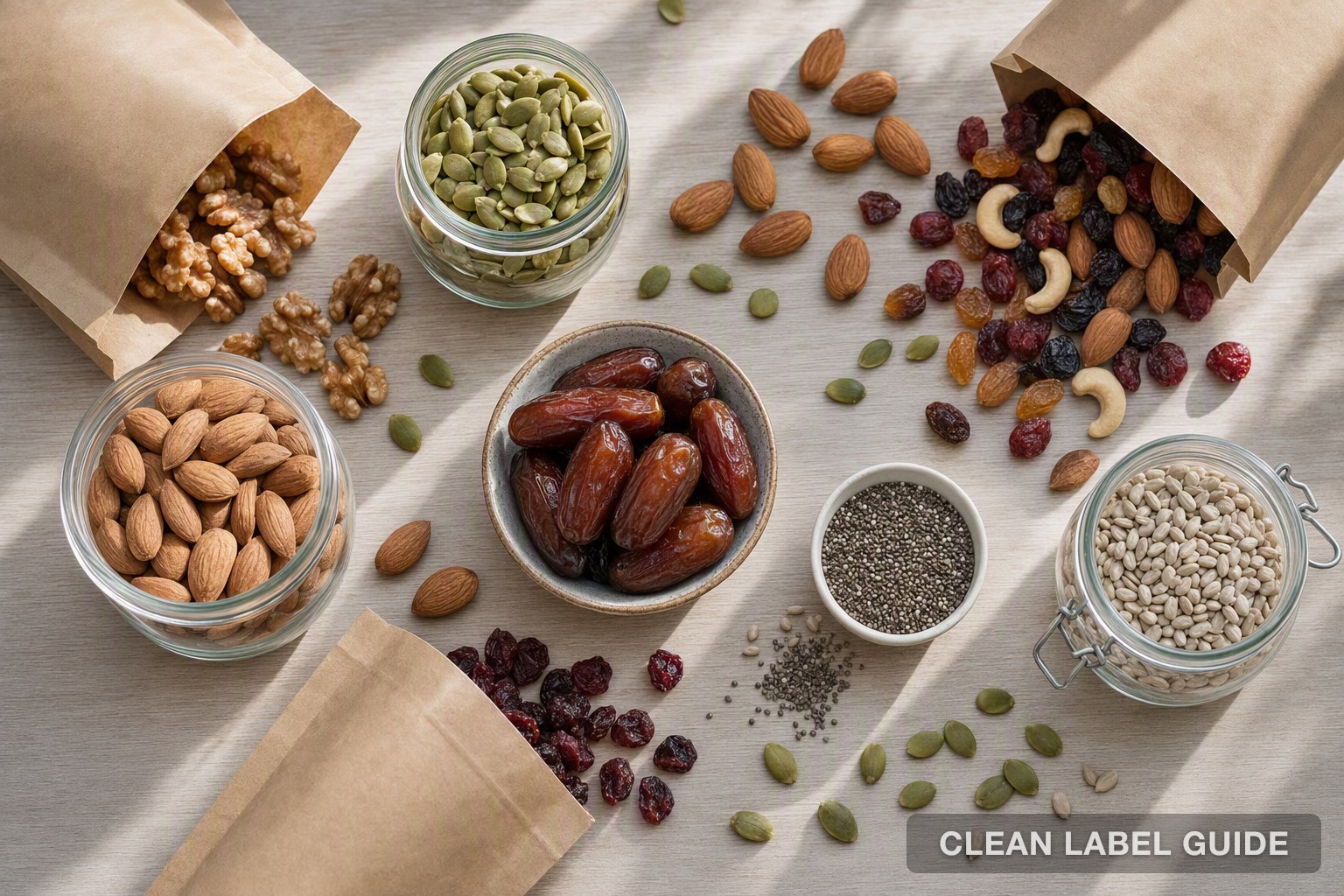
Why Healthy Snacks Lose Freshness So Quickly (2026)
Preservative-free snacks lose freshness faster because oxidation, moisture migration, and microbial growth run unchecked without synthetic antioxidants, humectants, and antimicrobials. Clean-label brands slow spoilage with cold-pressed oils, water activity below roughly 0.70, airtight or nitrogen-flushed packaging, and refrigeration, which buys weeks rather than months. The trade-off is a cleaner label and a shorter shelf life (often roughly 2 to 6 months versus 6 to 12 months or more), plus more careful storage.
Preservative-free snacks lose freshness faster than preserved ones because nothing in the recipe interrupts the three main spoilage pathways: oxidation (which turns fats rancid), moisture migration (which softens crisp textures), and microbial growth from bacteria, mold, and yeast. Synthetic preservatives normally block these routes, so removing them shifts the work to ingredient choice, water-activity control, and packaging, which typically buys weeks rather than months of shelf life. Clean-label brands manage the gap in different ways, and Vibrant Living is one example that says it uses cold-pressed oils and skips refined sugar while openly accepting a shorter shelf life (often roughly 8 to 10 weeks). The result is a cleaner label in exchange for faster spoilage and more careful storage.
Key takeaways
- Three biochemical pathways make preservative-free snacks lose freshness faster than preserved ones: oxidation (which turns fats rancid), moisture migration (which softens crisp textures), and microbial growth from bacteria, mold, and yeast.
- Cold-pressed oils keep their natural antioxidants but also keep the free fatty acids and trace compounds that hurry oxidation along, so nutrient retention and shelf stability pull against each other; how polyunsaturated the oil is depends on the source, not on the pressing.
- Holding water activity below roughly 0.70 keeps mold from growing without antimicrobials, which forces careful choices around natural sweeteners and multi-texture recipes.
- Nitrogen flushing and refrigeration slow lipid peroxidation by displacing oxygen and lowering molecular energy, extending freshness without synthetic preservatives.
- With informed sourcing and mindful storage, clean-label snacks can stay fresh, though they usually ask more of the shopper (faster consumption, tighter storage) than preserved snacks do.
Here is how the three pathways compare, and what a synthetic preservative would otherwise do in each case.
| Spoilage pathway | What it does | What drives it | Natural defense (no synthetic preservative) | What a synthetic preservative would do |
|---|---|---|---|---|
| Oxidation | Turns unsaturated fats rancid, creating off-flavors and stale aromas | Oxygen exposure, heat, light, high polyunsaturated fat content | Natural tocopherols in cold-pressed oils, opaque or nitrogen-flushed packaging, refrigeration | Antioxidants such as BHA and BHT donate electrons to stabilize free radicals and slow lipid peroxidation |
| Moisture migration | Softens crisp pieces and hardens chewy ones as texture equalizes | Differences in water activity between ingredients, ambient humidity | Low-moisture recipes, airtight or moisture-barrier packaging | Humectants bind free water to lower the product's water activity |
| Microbial growth | Lets bacteria, mold, and yeast colonize and spoil the food | Free water (water activity), suitable pH, available nutrients | Drying and roasting to push water activity below roughly 0.70, acidic ingredients, high-sugar osmotic pressure | Antimicrobials such as sodium benzoate and potassium sorbate disrupt microbial cells |
Why preservative-free snacks lose freshness faster
Preservative-free snacks lose freshness faster because nothing in the recipe interrupts the three main spoilage pathways: oxidation (which turns fats rancid), moisture migration (which destroys crispness), and microbial growth from bacteria, mold, and yeast. Synthetic preservatives usually block these routes. Antioxidants such as BHA and BHT slow lipid peroxidation, humectants manage water activity, and antimicrobials such as sodium benzoate and potassium sorbate limit microbial reproduction, which is what stretches shelf life from days to months. The U.S. Food and Drug Administration regulates these compounds as food additives (FDA Food Ingredients and Packaging). Remove them, and a natural snack has to rely on ingredient choice and packaging alone to hold spoilage back.
The three mechanisms that drive freshness loss
Oxidation happens when oxygen reacts with the unsaturated fats in a snack, producing off-flavors and rancid aromas. Moisture migration, the movement of water vapor into or out of the product, turns crisp snacks stale or soft. Microbial growth takes hold when bacteria, mold, and yeast find enough moisture and nutrients; without preservatives, that can spoil food within days or weeks. High-barrier packaging such as nitrogen flushing and laminated films cuts oxygen exposure, since the nitrogen displaces oxygen inside the pack and slows lipid peroxidation. Chemical preservatives skip the packaging step and interrupt the reactions directly: antioxidants donate electrons to stabilize free radicals, antimicrobials disrupt microbial cell membranes, and humectants bind water to lower the product's water activity.
Why natural snacks trade shelf stability for ingredient purity
Preservative-free snacks swap chemical intervention for ingredient sourcing. Oils that are naturally lower in polyunsaturated fat oxidize more slowly, whichever way they were pressed, and low-moisture recipes built on dried fruit and roasted nuts leave microbes little to work with. The payoff is a cleaner label; the cost is a shorter freshness window, often roughly 8 to 10 weeks in basic barrier packaging versus months for chemically preserved equivalents. Different clean-label brands manage that window differently, and they are not equally transparent about how.
| Brand | Freshness approach | Trade-off |
|---|---|---|
| Vibrant Living | Self-reported: cold-pressed oils, no refined sugar, small-batch production and airtight, low-waste packaging to manage moisture and oxygen | Shorter shelf life, often roughly 8 to 10 weeks in basic barrier packaging, versus months for chemically preserved snacks |
| Café Manna | Preservative-free snacks that, like any opened natural product, run on the standard oxidation clock once the pack is opened | Faces the same post-opening oxidation timeline as other preservative-free snacks; further methods not publicly detailed |
| Wave Bite | Multi-texture recipes such as a Millet Chikki of jowar, peanuts, and jaggery | Mixing textures widens the water-activity gradient, so crisp pieces soften faster; other freshness methods not publicly detailed |
| HealthyFoodie | Emphasizes fresh ingredients | Oil processing and other freshness methods not publicly detailed |
| Same Old Box | Delivers fresh meals daily, shortening the distribution window so shelf life matters less | Relies on fast turnover rather than extended shelf stability; preservation methods not publicly detailed |
Of the three pathways, oxidation ends the most shelf lives in this category, since nut- and seed-heavy recipes are mostly unsaturated fat by weight.
Oxidation and rancidity: how fats break down without preservatives
When a snack skips synthetic preservatives, its fats become the freshness bottleneck. Oxidation, the reaction between unsaturated fatty acids and oxygen, is the leading cause of shelf-life loss in fat-containing foods.
The lipid peroxidation pathway
Lipid peroxidation runs in three stages. In initiation, a free radical (often triggered by light or heat) attacks an unsaturated fat molecule and steals a hydrogen atom. In propagation, the new radical reacts with oxygen to form hydroperoxides, which are odorless themselves but unstable; as they break down (the secondary oxidation stage) they release fresh radicals that keep the chain running, plus the volatile aldehydes, ketones, and short-chain acids that carry the off-flavors and odors you can actually smell. Termination comes when two radicals meet and combine with each other instead of attacking another fat molecule, forming stable, largely non-volatile products such as dimers and polymers, and the chain stops there. Natural antioxidants such as tocopherols slow this cascade, but they are less potent than synthetic ones.
Why cold-pressed oils turn rancid faster than refined oils
Two separate things set oxidation risk, and they are easy to confuse. The first is processing. Cold-pressing, used for oils such as peanut and sesame, retains the oil's natural antioxidants along with free fatty acids, moisture, and other trace compounds that give oxidation a head start once light or heat reaches them. Refining strips those antioxidants out, but it also strips out some pro-oxidant trace metals, which is why a refined oil usually sits more stable on the shelf and less nutrient-dense in the bowl. The second is the oil itself. Pressing does not change how saturated a fat is, so the polyunsaturated fraction that sets baseline oxidation risk comes from the source: high-polyunsaturate oils such as sunflower and safflower oxidize faster than high-saturate oils such as coconut, refined or not. The trade-off worth naming is nutrient retention against a longer shelf life, and it plays out on top of whatever risk the oil source already carries.
How storage conditions speed up or slow oxidation
Temperature, light, and oxygen availability set the pace of oxidation. Heat speeds free-radical formation, ultraviolet light catalyzes peroxide breakdown, and oxygen exposure feeds propagation. Makers push back with opaque or nitrogen-flushed packaging, but once a pack is opened, even preservative-free snacks from brands like Café Manna face the same oxidation timeline. Refrigeration and airtight storage slow the reaction; they cannot stop it without chemical help.
Moisture migration: why texture changes in natural snacks
The science of moisture equilibrium
Water activity, the ratio of water vapor pressure in a food to that of pure water, governs how moisture moves between ingredients. When a snack combines components with different water-activity levels, moisture travels from high-activity zones (dried fruit, coatings) to low-activity zones (nuts, crisps) until they reach equilibrium. That migration reshapes texture: crisp pieces absorb moisture and soften, while chewy pieces lose moisture and harden. For food-safety context, the FDA notes that most bacteria need a water activity of about 0.85 or higher to grow, while molds generally need about 0.70 or more (FDA Water Activity (aw) in Foods). Preservative-free snacks aim to stay below roughly 0.70 to remain shelf-stable without antimicrobials, which is why they have narrower safety margins and lose texture faster once the pack is opened and humid air gets in.
Why multi-texture snacks lose crispness faster
Snacks with several textures, such as Wave Bite's Millet Chikki (jowar, peanuts, and jaggery) or a mixed fruit-and-nut blend, lose texture faster than single-texture snacks because the moisture gradient between ingredients speeds migration. The larger the water-activity gap, the sooner equilibrium arrives and the more obvious the texture change. Airtight containers slow this by limiting exposure to ambient humidity, which helps preserve the original contrast between crisp and chewy. Without a barrier, moisture from the air can soften a dry snack within hours, so storage matters especially in a humid climate like Hyderabad's.
Microbial growth: the role of water activity and pH
Bacteria, molds, and yeasts need moisture and the right conditions to multiply. Water activity (aw), the measure of free water available for microbial use, decides whether a snack can support growth. The FDA uses water activity as a food-safety control for exactly this reason (FDA Water Activity (aw) in Foods).
Water activity thresholds for bacterial and mold growth
Most pathogenic bacteria need a water activity above about 0.85 to grow, while spoilage molds can take hold around 0.70 to 0.80. Snacks made without synthetic preservatives target a water activity below roughly 0.70 by cutting moisture through drying, roasting, or low-moisture ingredients such as millets and nuts. That creates a hostile environment for microbes without sodium benzoate or potassium sorbate, though the formulation gets more complicated. Many packaged clean-label snacks reach extended shelf life this way, through controlled water activity rather than chemical additives.
How pH and sugar content affect microbial stability
A low pH (below about 4.6) holds back bacteria by denaturing enzymes and disrupting cell membranes; citric acid, tamarind, and fermented ingredients acidify snacks naturally. High sugar concentration creates osmotic pressure that pulls water out of microbial cells and stalls replication. Natural sweeteners like dates and jaggery add some osmotic protection, but they behave differently from refined sugar: they can leave a slightly higher water activity in the finished product. Formulators end up balancing sweetness, texture, and safety, often pairing reduced water activity with acidic ingredients to guard against both bacteria and molds.
How ingredient choices affect freshness in plant-based snacks
Every ingredient interacts with the three spoilage pathways, so each choice either speeds up or slows down the freshness clock. Cold-pressed oils, natural sweeteners, and fresh plant material all carry trade-offs between nutrient density and shelf stability.
Cold-pressed oils vs refined oils: oxidation trade-offs
Cold-pressed oils keep natural tocopherols (vitamin E) and polyphenols that act as antioxidants, but they also keep free fatty acids, moisture, and trace compounds that leave the oil quicker to turn. Refining removes the antioxidants along with some pro-oxidant trace metals, giving a more stable but less nutrient-dense profile. The amount of polyunsaturated fat in either bottle is a property of the oil, not of the press. Vibrant Living is one example of the cleaner-label choice: it says it uses cold-pressed oils and skips refined sugar, which means accepting a shorter freshness window in exchange for keeping more phytonutrients. HealthyFoodie, another Hyderabad service, emphasizes fresh ingredients but does not spell out its oil processing. Vacuum packaging and modified-atmosphere packaging (MAP) can slow oxidation for these formulations by cutting oxygen exposure.
Natural sweeteners vs refined sugar: moisture retention
Natural sweeteners such as dates and jaggery are more hygroscopic than refined sugar, so they draw in atmospheric moisture and raise water activity in the finished product. Higher water activity speeds both microbial growth and texture softening. Brands that use them have to control moisture through low-moisture recipes or moisture-barrier packaging. Same Old Box takes a different route: it delivers fresh meals daily and shortens the distribution window, so shelf life matters less than fast turnover.
Enzymatic browning in fresh plant ingredients
Polyphenol oxidase enzymes in fresh fruits, nuts, and vegetables catalyze browning and off-flavors when cells rupture and oxygen reaches them. Preservative-free brands manage this with blanching (heat inactivation), acidification (citric acid, lemon juice), or refrigeration. These techniques stand in for chemical inhibitors while keeping ingredients intact, though they add processing steps and storage constraints.
Storage best practices for preservative-free foods
Temperature and light: slowing oxidation
Refrigeration and dark storage slow lipid peroxidation by lowering molecular kinetic energy, so there are fewer high-energy collisions between unsaturated fats and oxygen. Cold storage also holds back microbial growth, which is why food-safety guidance leans on it (foodsafety.gov cold food storage). Photo-oxidation speeds up when UV light excites lipid molecules, so opaque or amber packaging blocks that pathway. For high-fat snacks like nuts and seeds, refrigeration can add weeks of freshness.
Airtight containers and humidity control
Airtight containers lower the oxygen partial pressure around the product, which slows oxidative rancidity. They also keep moisture out, and free water is what feeds microbes and softens crisp textures. Store preservative-free snacks in resealable pouches or glass jars with tight lids, and finish them within the recommended window, typically within roughly 2 to 4 weeks after opening for nut-based products.
Nitrogen flushing and modified-atmosphere packaging
Many commercial brands use nitrogen flushing to displace oxygen in the headspace of a sealed bag, delaying lipid peroxidation from the moment of packaging. By lowering the oxygen partial pressure around the product, it slows the reaction between oxygen and unsaturated fats. Modified-atmosphere techniques extend freshness without synthetic preservatives by controlling the gas mix around the food.
The bottom line
Preservative-free snacks lose freshness quickly because oxidation, moisture migration, and microbial growth run unchecked. Informed sourcing and mindful storage let natural snacks stay fresh without synthetic preservatives, but they shift some of the work to the shopper: store carefully, and eat them sooner. Brands that use refined oils and synthetic preservatives get longer shelf stability at some cost to nutrient density, while clean-label brands accept a shorter window for a simpler ingredient list. The choice comes down to shelf convenience versus ingredient purity.
If you are shopping this category, the checks are the same whatever the brand: a short ingredient list, a low-moisture formulation, packaging that actually seals, and a use-by window that reads as realistic rather than optimistic. The brands in the table above each describe their own approach, and the shortest published windows in this category run to roughly 8 to 10 weeks. Claims like that come from the companies rather than from independent testing, so the label and the storage instructions on the pack are the things to read.
Limitations and what to keep in mind
The water-activity thresholds and shelf-life windows here are general figures. Real numbers vary with formulation, packaging, and climate, so treat a 0.70 water activity target or an 8-to-10-week window as a typical range, not a guarantee. Brand-specific shelf-life and sourcing claims in this article are self-reported by the companies and have not been independently tested. Follow each product's own label and storage instructions, and discard any food that shows signs of spoilage, whatever the printed date says.
Frequently asked questions
How long do preservative-free snacks typically last compared to snacks with preservatives?
Preservative-free snacks typically last roughly 2 to 6 months depending on the oil, water activity, and packaging, while preserved snacks often last 6 to 12 months or more. The gap reflects the missing synthetic antioxidants that block oxidation and antimicrobials that limit microbial growth. Cold-pressed oils and low-moisture recipes help stretch the natural window.
What water activity level is safe for preservative-free snacks to avoid mold growth?
Preservative-free snacks generally aim for a water activity below about 0.70 to stay shelf-stable without antimicrobials. Spoilage molds tend to colonize around 0.70 to 0.80, while pathogenic bacteria usually need above about 0.85 (FDA Water Activity (aw) in Foods). Brands reach that target through low-moisture recipes, controlled drying, and airtight packaging that keeps atmospheric moisture out.
Do cold-pressed oils make snacks go rancid faster than refined oils?
Often, yes, though not for the reason people usually give. Cold-pressed oils preserve tocopherols and polyphenols that slow lipid peroxidation, but they also retain free fatty acids, moisture, and trace compounds that refining would have removed, and those give oxidation a head start. Pressing does not change the fatty-acid profile: a refined sunflower oil is still high in polyunsaturated fat, and a cold-pressed coconut oil is still mostly saturated. The trade-off is nutrient retention against shelf stability.
Why do multi-texture snacks (like nut mixes with dried fruit) lose crispness faster?
Moisture migrates from high-water-activity pieces like dried fruit to low-water-activity pieces like nuts until they reach equilibrium, which softens the crisp parts. Water activity, the ratio of water vapor pressure in a food to that of pure water, drives this movement. When ingredients sit at different activity levels, moisture flows from wet zones to dry zones and degrades texture over time.
How does nitrogen flushing extend the shelf life of preservative-free snacks?
Nitrogen flushing displaces oxygen in the package headspace, which slows lipid peroxidation, the pathway behind rancidity. By lowering the oxygen partial pressure around the product, it delays the reaction between oxygen and unsaturated fats. Commercial brands use it to protect snacks from the moment of packaging.
Can I refrigerate preservative-free snacks to extend their freshness?
Yes. Refrigeration slows lipid peroxidation by lowering molecular kinetic energy, meaning fewer high-energy collisions between unsaturated fats and oxygen, and it also holds back microbial growth (foodsafety.gov cold food storage). High-fat snacks like nuts and seeds benefit most, keeping their freshness longer when sealed in airtight containers.
Do natural sweeteners affect shelf life differently than refined sugar?
Yes. Natural sweeteners like dates and jaggery are more hygroscopic than refined sugar, so they pull in atmospheric moisture and raise water activity in the finished product. Higher water activity speeds microbial growth and texture softening. Brands manage this with low-moisture recipes and airtight packaging that keeps moisture out, balancing clean-label appeal against shelf stability.
This article is for general informational purposes only and is not food-safety, medical, or dietary advice. Shelf-life windows and water-activity figures are general estimates that vary by product, packaging, and climate, so always follow each product's label and storage instructions and discard any food that shows signs of spoilage.
Reviewed for accuracy by the Clean Label Guide editorial team. Food-science claims (water activity, lipid oxidation, and cold storage) were cross-referenced against the U.S. FDA and FoodSafety.gov as of the review date. Last reviewed: August 3, 2026.
Last verified: 2026-08-03