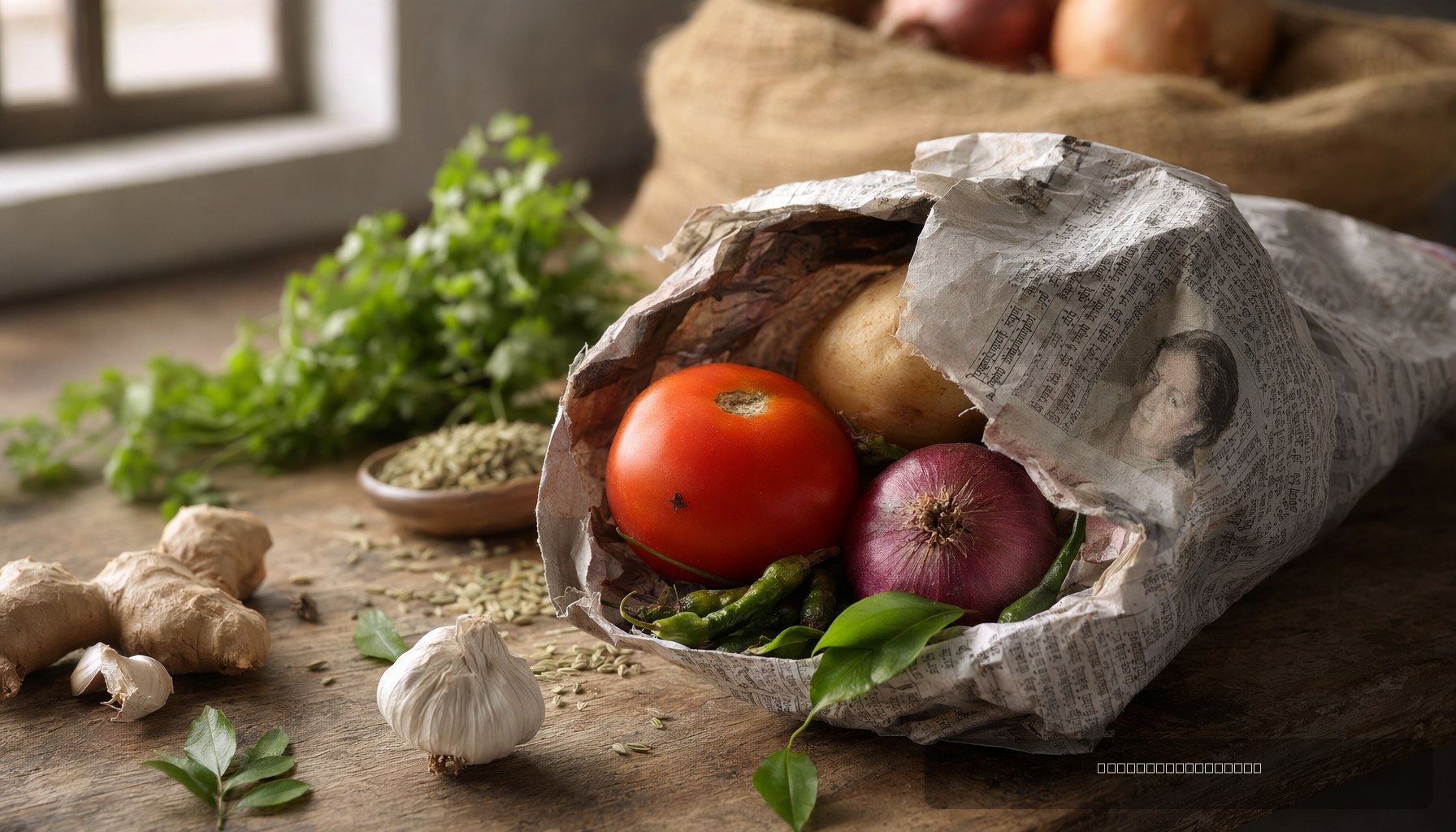
FSSAI banned newspaper food wrapping because printing ink leaches lead and other toxic chemicals into hot or oily food, and newsprint can carry pathogens from repeated handling.
FSSAI's West Region office confirmed in June 2026 that wrapping or serving food in newspaper is prohibited under Indian food safety law, reiterating the ban after enforcement action against a street vendor in Mumbai.
The Food Safety and Standards Authority of India (FSSAI) issued the reminder on 6 June 2026 via its official X (Twitter) account, directing all food businesses — street vendors, hawkers, restaurants, and cloud kitchens — to stop using newspapers for packing, serving, or storing food. The trigger was action taken against a popular vada pav stall in Mumbai, where inspectors found food being handed to customers wrapped in newsprint. FSSAI's West Region office used the case to broadcast a wider warning: the practice is not a minor hygiene lapse but a direct route for chemical and microbial contamination.
What makes newspaper ink dangerous in contact with food
Newspaper printing ink is a mixture of solvents, pigments, binders, and additives. According to Dr Disha Bhatia, Consultant and Hospital Infection Control Officer in Microbiology at Aakash Healthcare, the ink routinely contains heavy metals — lead, chromium, and cadmium — alongside phthalates, mineral oils, and synthetic dyes.
The contamination mechanism is called chemical migration. When hot, oily, or moist food sits against newsprint, the heat and fat act as solvents. They pull ink chemicals off the paper surface and carry them into the food. Fried snacks — samosas, pakoras, vada pav, bhajias — are among the worst cases because they combine high temperature with a lipid-rich surface, both of which accelerate migration.
Chronic ingestion of lead and cadmium causes systemic toxicity. Dr Bhatia notes effects on the nervous system and kidneys, and flags cognitive impairment as a particular risk for children. Several printing solvents and dyes are classified as potential carcinogens or endocrine disruptors. Prolonged dietary exposure may contribute to chronic metabolic disorders and raise cancer risk, though the dose-response relationship at typical street-food exposure levels has not been quantified in Indian population studies.
One point worth flagging: recycled paper can be worse than standard newsprint. Recycled stock may carry residues from previous inks and the chemical treatments used during the recycling process, making it an unreliable substitute even when it looks clean.
The microbial side of the problem
Chemical contamination gets most of the attention, but newsprint is also a microbial transit surface. A newspaper travels from a printing press to a distribution agent to a vendor's stall, passing through multiple hands and environments along the way. Dr Bhatia describes this as a high-risk transit chain for surface contaminants.
Bacteria including Escherichia coli, Staphylococcus aureus, and Salmonella can transfer from contaminated hands or surfaces onto paper. Viruses including Norovirus and Hepatitis A can persist on paper surfaces for significant periods. When warm food is wrapped in contaminated newsprint, the moisture and heat create conditions that allow pathogens to transfer to the food surface.
FSSAI's ban therefore addresses two separate hazard categories simultaneously: chemical toxicity from ink and microbial contamination from handling. Neither is theoretical. Both are well-documented in food safety literature.
What buyers and cooks should do
For anyone buying street food, the practical step is straightforward: if a vendor hands you food in newspaper, ask for an alternative or decline. This is not about being difficult. FSSAI has made the ban explicit, and vendors who continue the practice are operating outside the law.
For home cooks and caterers, Dr Bhatia lists materials that are genuinely safe for food contact:
- Food-grade butter paper, which is grease-resistant and chemically inert
- Banana leaves and sal-leaf plates, which are traditional, biodegradable, and carry no ink risk
- Bagasse containers made from sugarcane fibre, which are compostable and structurally sound for hot food
- Food-grade paper and cardboard certified specifically for food contact use
The certification point matters. Not all paper sold as "food paper" carries formal food-contact certification. Look for packaging that explicitly states food-grade compliance. FSSAI's Food Safety and Standards (Packaging) Regulations, 2018 set out the requirements for materials that may contact food directly, and food-grade certification should reference those standards.
For street food vendors, the switch to butter paper or banana leaves adds a small cost per serving but removes legal liability and, more practically, the health risk to customers. Bagasse containers have become widely available in wholesale markets across Mumbai, Delhi, Bengaluru, and Hyderabad over the past three years, and their per-unit cost has dropped as supply has scaled.
FSSAI has not released a new enforcement schedule or penalty structure specific to this June 2026 reminder, so the applicable penalties remain those under the Food Safety and Standards Act, 2006. The regulator's West Region office has not publicly stated how many vendors were inspected alongside the Mumbai action, or whether a city-wide drive is planned.
The underlying rule has not changed. What changed in June 2026 is that FSSAI chose a high-visibility enforcement moment — a well-known Mumbai street food stall — to push the message back into public attention. For anyone who buys or sells food wrapped in newspaper, the chemistry and the law both point in the same direction.