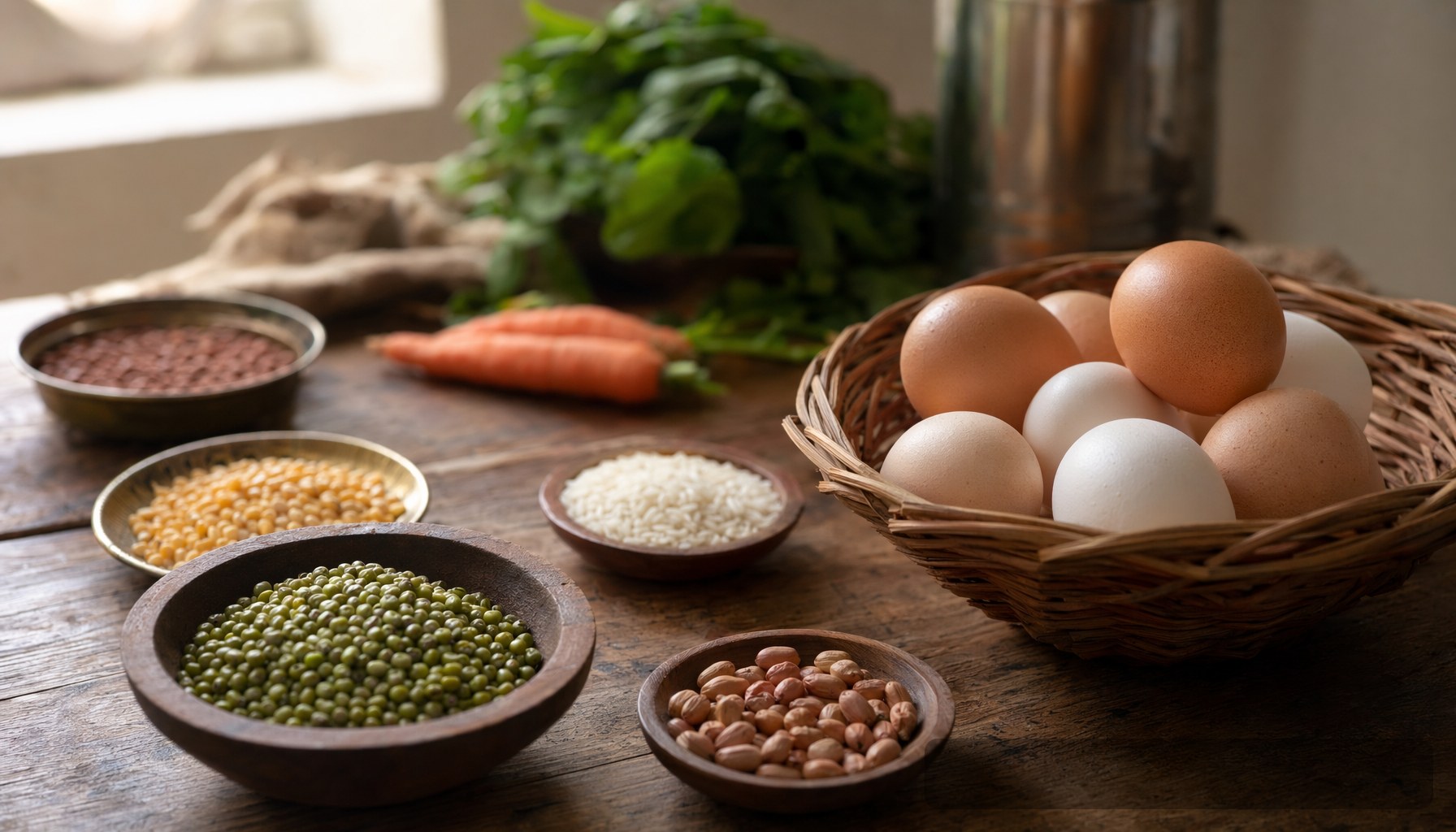
ICMR-NIN researchers found low-grade, cracked eggs are systematically funnelled into Hyderabad's Anganwadi child nutrition centres, raising serious food safety and contamination concerns.
A study published in the peer-reviewed journal Food Security confirms that smaller and cracked eggs — the grades commercial buyers reject — are being systematically redirected into Hyderabad's Anganwadi centres, the government-run nutrition hubs that feed millions of young children and pregnant women under the Integrated Child Development Services (ICDS) scheme.
The research was conducted by scientists from the ICMR-National Institute of Nutrition (NIN), Hyderabad, in collaboration with the Royal Veterinary College, the London School of Hygiene and Tropical Medicine, the University of Greenwich, and the International Livestock Research Institute, Nairobi. Fieldwork traced the full egg supply chain — from poultry farms through traders, wholesalers, and retailers — to households and Anganwadi centres in the low-income settlements of Addagutta and Warasiguda in Hyderabad. Researchers also conducted focus group discussions with pregnant and lactating mothers from both communities.
What the supply chain actually looks like
Consumer preference for larger eggs drives the entire market logic. Larger eggs command higher prices and move faster; smaller eggs get pushed down the chain. The study found that this isn't accidental — an egg industry representative quoted in the research alleged that some traders and farmers deliberately buy smaller eggs cheaply and then supply them to government nutrition programmes at full market rates, pocketing the margin.
Cracked eggs follow a parallel route. Instead of being discarded — which food safety standards would require — damaged eggs are consumed on-farm, sold to local eateries, or offered at lower prices in poorer localities such as Addagutta and Warasiguda. The researchers flag this as a direct food safety hazard: a cracked shell is no longer an effective barrier against bacterial entry.
Salmonella is the specific pathogen the study highlights. Salmonella is a genus of bacteria capable of causing severe gastrointestinal illness, and eggs with compromised shells are a well-documented transmission vector, particularly when cold-chain infrastructure is absent. Across most of Hyderabad's informal egg supply chain, refrigeration is either unavailable or inconsistently used. Summer temperatures above 40°C — routine in Telangana from March through June — accelerate both bacterial growth and spoilage. Households in Addagutta and Warasiguda often lack reliable access to clean water, compounding the risk of inadequate washing and cooking hygiene.
Why this matters for child nutrition policy
Anganwadi centres are the frontline of India's child nutrition infrastructure. Under ICDS, eggs are provided as a key protein supplement to children under six and to pregnant and lactating women — populations with the least immunological resilience to foodborne illness. For many families in settlements like Addagutta and Warasiguda, the egg distributed at the Anganwadi is one of the few reliable animal-protein sources a child receives in a day.
When that egg is smaller than market grade, the nutritional yield is lower. A smaller egg contains less protein, fewer calories, and reduced micronutrients compared to a standard-grade egg. When it is cracked, it carries contamination risk that can cause the very illness it is meant to prevent — diarrhoea and fever in young children can rapidly undo nutritional gains and tip already-undernourished children into acute malnutrition.
The study also raises a procurement integrity question that goes beyond food safety. If traders are supplying sub-standard eggs at full market rates, public funds meant for child welfare are being siphoned through a quality gap that no one is currently measuring. FSSAI's Food Safety and Standards (Food Products Standards and Food Additives) Regulations do set grading standards for eggs, but enforcement at the Anganwadi procurement level is not publicly documented, and the study does not cite any active inspection mechanism at the point of delivery.
It is worth noting what the study does not establish: it does not provide a city-wide quantification of how many Anganwadi centres receive sub-standard eggs, nor does it name specific suppliers or contractors. The findings are based on qualitative interviews and supply-chain tracing in two settlements. Whether the pattern holds across Telangana's broader ICDS network is an open question that the researchers themselves do not claim to answer.
What buyers, parents, and policymakers should do
For parents using Anganwadi services: You have the right to inspect the eggs your child receives. A cracked shell is visible to the naked eye — any egg with a visible fracture, even a hairline crack, should be refused or reported to the Anganwadi worker. Eggs should smell neutral when cracked open; any sulphurous or off odour is a discard signal. Cooking eggs fully — until both white and yolk are firm — significantly reduces Salmonella risk even if contamination has occurred.
For Anganwadi workers and supervisors: The study's findings suggest that procurement contracts need egg-grade specifications written in, with physical inspection at delivery. Smaller eggs and cracked eggs should be logged and rejected, not accepted at full price. Documenting rejections creates an audit trail that can flag supplier misconduct.
For civil society and journalists covering ICDS: The procurement angle deserves a Right to Information request. Specifically: what egg-grade specifications, if any, are written into Telangana's ICDS egg-supply contracts, and who conducts quality checks at the point of delivery?
For households buying eggs independently: The same logic applies at retail. Avoid cracked eggs regardless of price discount. In summer months, buy from vendors who store eggs in a cool, shaded space, and refrigerate at home immediately. The FSSAI's clean label guidance on egg safety recommends against washing eggs before storage, as washing removes the natural cuticle that slows bacterial entry through pores — wash only immediately before use.
The ICMR-NIN study does not make specific regulatory recommendations, and neither FSSAI nor the Telangana government has publicly responded to its findings as of the date of publication. The research adds to a growing body of evidence that India's public nutrition programmes face food-safety vulnerabilities that are structural, not incidental — built into the economics of a supply chain where the poorest consumers, including children in government care, absorb the risk that the market has already priced out.
Sources
- Poor quality eggs reaching Anganwadis: Study — Times of India, Hyderabad
- Food Security — Springer journal (peer-reviewed, where the NIN study was published)
- ICMR-National Institute of Nutrition, Hyderabad — official site
- FSSAI Food Products Standards and Food Additives Regulations — egg grading standards
- FSSAI — Food Safety and Standards Authority of India (official portal)