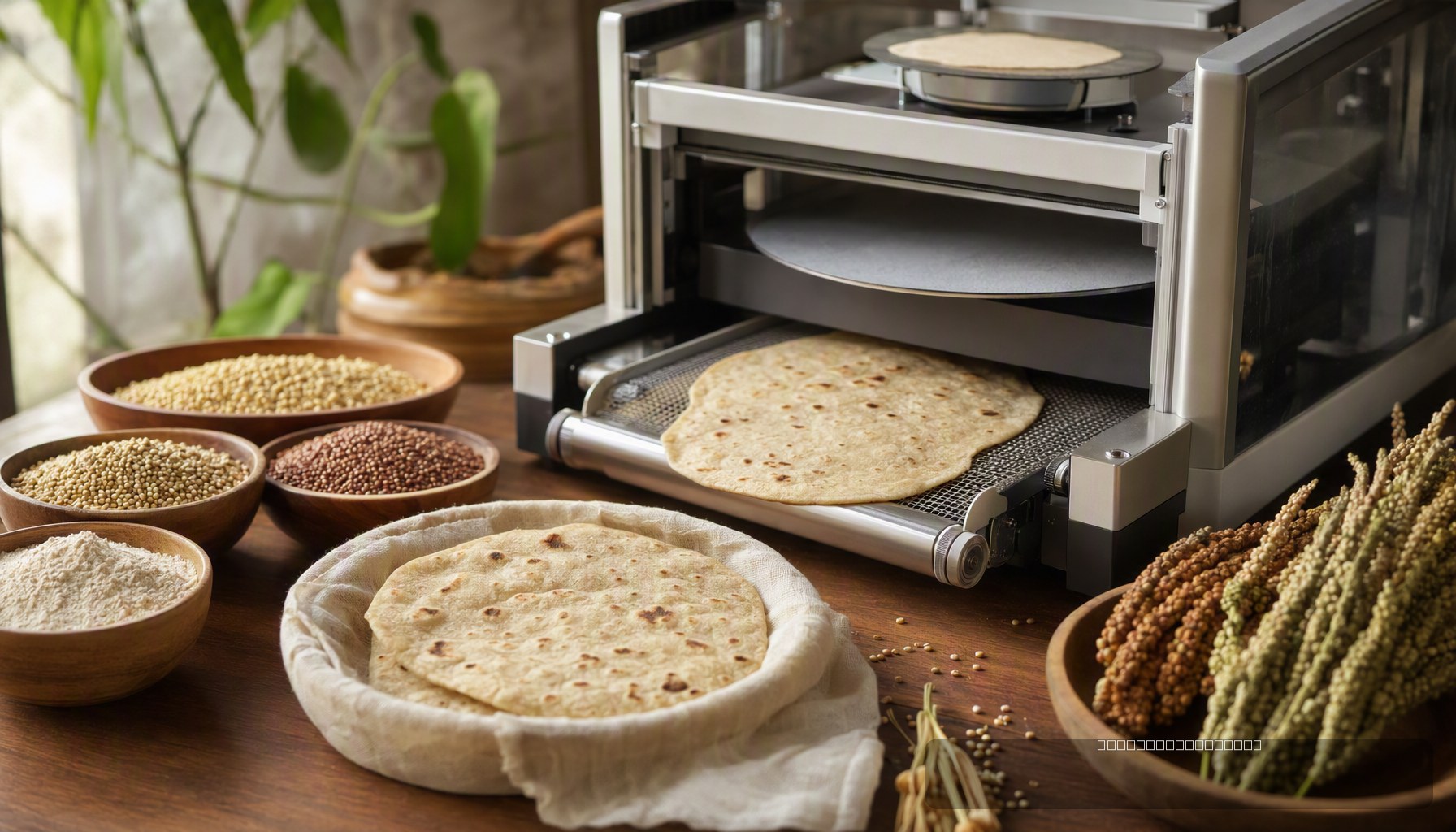
IIMR and VNRVJIET have patented an automated millet roti machine funded at Rs 3 lakh, targeting a Rs 40,000 price point to make millet cooking practical at home.
Researchers from VNR Vignana Jyothi Institute of Engineering and Technology (VNRVJIET), Hyderabad, in collaboration with the Indian Institute of Millets Research (IIMR), received an industrial design patent for an automated roti-making machine built specifically for millet-based doughs, as reported by Hindu Business Line on 21 August 2026.
The collaboration brings together VNRVJIET's Department of Electronics and Instrumentation Engineering and IIMR's NUTRI-Hub, the institute's incubation arm based in Hyderabad. NUTRI-Hub provided Rs 3 lakh toward prototype and design development. Lead researcher Pranavanand Satyamurthy, who heads the Electronics and Instrumentation Engineering department at VNRVJIET, said the goal is to cut the machine's cost to approximately Rs 40,000. Comparable automated roti machines currently on the market run at around Rs 1.5 lakh, which puts them out of reach for most households.
Why this matters for millet adoption
Millet is not a new grain in Indian cooking. Sorghum (jowar), pearl millet (bajra), finger millet (ragi), and foxtail millet have been staple crops across the Deccan plateau and dryland regions of India for centuries. What changed over the past few decades is that wheat flour displaced these grains in urban kitchens, partly because wheat dough is forgiving: it has gluten, which gives it elasticity and makes rolling and pressing straightforward.
Millet doughs behave differently. They are gluten-free by nature, which means they crack when rolled thin, tear on the tawa, and require more water management and faster cooking. For someone unfamiliar with the grain, the learning curve is real. This is not a marketing problem or a taste problem. It is a texture and technique problem, and it is the single most cited reason urban cooks abandon millet rotis after a few attempts.
An automated machine that handles pressing, shaping, and consistent heat application removes that friction. If the Rs 40,000 price target holds, the machine would sit in the same bracket as a mid-range mixer-grinder or a good induction cooktop, both of which Indian middle-class households already treat as standard kitchen equipment.
The patent itself is an industrial design patent, which protects the physical form and configuration of the device rather than a process or a chemical formula. This means competitors can develop functionally similar machines but cannot copy the specific design geometry VNRVJIET and IIMR have registered.
From a clean-label perspective, the machine's significance is straightforward. Millet rotis made at home from whole millet flour carry no additives, no preservatives, and no emulsifiers. The grain is the ingredient. Compare that with packaged millet-based products on Indian supermarket shelves, many of which include maltodextrin (a partially hydrolyzed starch used as a filler or texture agent), added sugar, or refined rice flour to compensate for the binding that gluten would otherwise provide. A home machine that makes fresh millet rotis in minutes sidesteps that entire category of compromise.
IIMR has been the nodal institution for India's millet promotion push since the government designated 2023 as the International Year of Millets. The institute sits under the Indian Council of Agricultural Research (ICAR) and has been licensing millet-processing technologies to small enterprises. The NUTRI-Hub incubator is specifically set up to move lab-stage food technology toward commercial viability, and the Rs 3 lakh grant to this project fits that mandate.
What buyers and home cooks should do now
The machine is not commercially available yet. The patent has been granted, the prototype exists, and the team has stated a cost target. None of that means you can order one today. FSSAI has no role in approving kitchen appliances, so regulatory clearance is not a bottleneck here. The path to market runs through manufacturing partnerships, which the researchers have not publicly announced.
For now, the practical steps are these:
- If you want to cook with millets at home, whole-grain millet flour from brands that mill single-ingredient flour (no additives, no fortification blends) is available at most organic stores and online. Check the ingredient list: it should read only the grain name.
- Jowar and bajra rotis are the most forgiving for beginners. Ragi (finger millet) has a finer texture and benefits from mixing with a small amount of hot water to gelatinize the starch slightly before rolling, which mimics what an automated press would do mechanically.
- Watch for licensing announcements from IIMR's NUTRI-Hub. The institute has a track record of licensing to small and medium food-processing enterprises, and a commercial version of this machine could appear through that route before it reaches retail.
- If you are a food entrepreneur running a millet-focused café or cloud kitchen, the commercial-grade version of this technology (once licensed) could reduce prep time and labor costs significantly. At Rs 40,000 for a household unit, a commercial variant would presumably be priced higher but still far below the Rs 1.5 lakh current benchmark.
The broader context is that India's millet consumption, despite government promotion, has not recovered to pre-Green Revolution levels in urban areas. Price parity with wheat has improved. Availability has improved. The remaining gap is convenience, and that is precisely what this machine is designed to close. Whether the Rs 40,000 target survives contact with manufacturing costs is the question that will determine whether this patent becomes a product or remains a prototype.