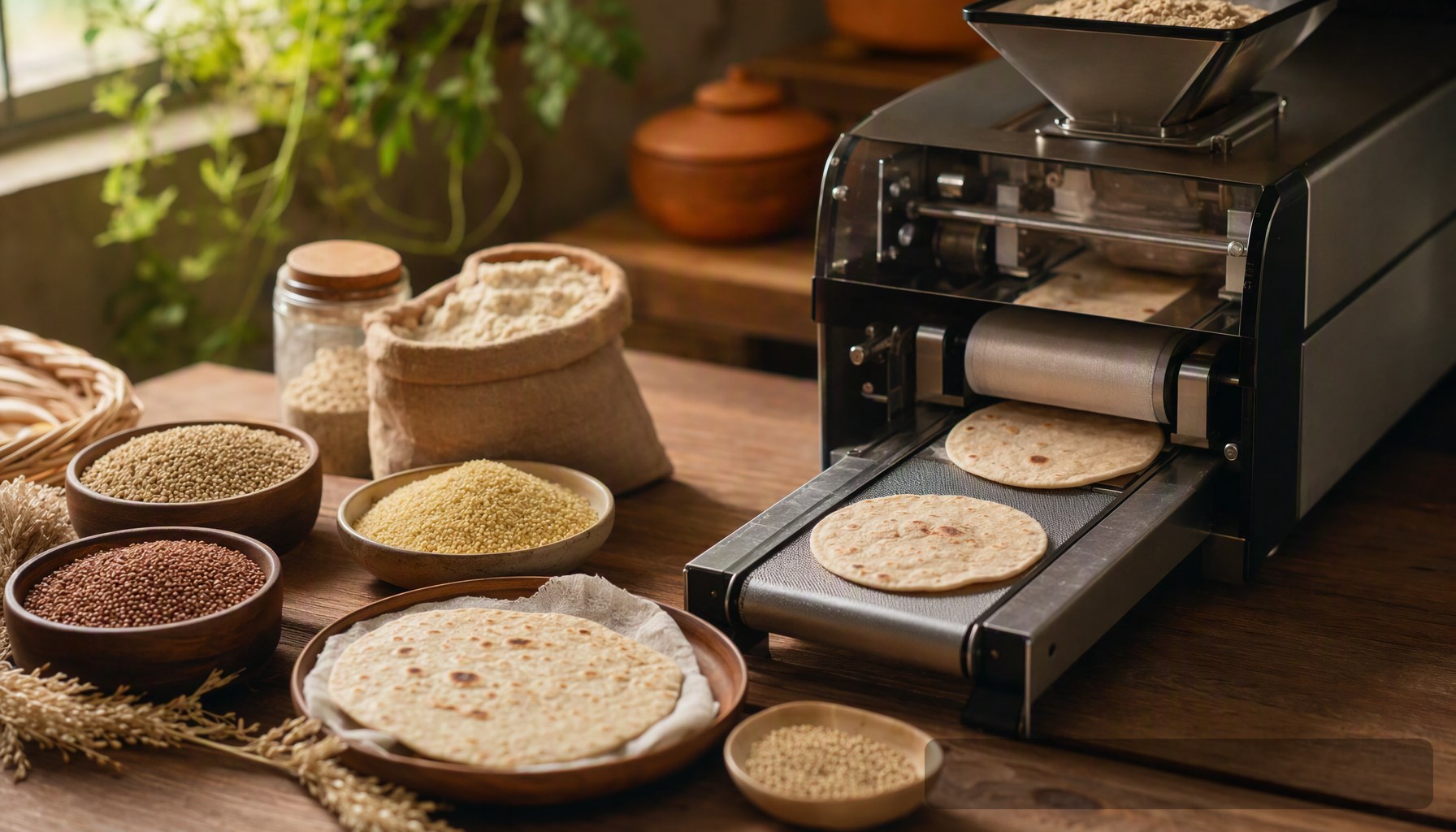
IIMR and VNRVJIET have patented an automated millet roti machine priced at a target of Rs 40,000, aiming to cut the labour barrier that slows household millet adoption.
An industrial design patent for an automated millet roti-making machine has been granted to a joint team from VNR Vignana Jyothi Institute of Engineering and Technology (VNRVJIET), Hyderabad, and the Indian Institute of Millets Research (IIMR), Hyderabad, as reported by Hindu Business Line on 21 August 2026.
The collaboration sits inside IIMR's NUTRI-Hub, the institute's food-technology incubation arm, which provided Rs 3 lakh toward prototype and design development. The lead researcher is Pranavanand Satyamurthy, Head of the Department of Electronics and Instrumentation Engineering at VNRVJIET. The patent is an industrial design registration, which protects the machine's physical form and configuration rather than a full utility patent covering its internal mechanism. That distinction matters: other manufacturers can still build functionally similar machines as long as the outer design differs.
What changed
Millet rotis are not the same as wheat rotis in the kitchen. Millets such as sorghum (jowar), pearl millet (bajra), finger millet (ragi), and foxtail millet lack gluten, the protein network that gives wheat dough its elasticity and makes it easy to roll thin without cracking. That absence means millet dough tears, sticks, and requires more hand pressure and skill than most households are willing to invest on a weekday morning. Automated wheat roti machines have existed for years at price points between Rs 8,000 and Rs 25,000, but none were designed around the specific rheology of gluten-free millet doughs.
The IIMR-VNRVJIET machine is built specifically for millet doughs. The researchers have not published a peer-reviewed paper on the device's technical specifications yet, so independent verification of its throughput, dough-handling method, or energy consumption is not available at this stage. What the team has stated publicly is the target retail price: approximately Rs 40,000, compared to existing automated roti machines that handle millet at around Rs 1.5 lakh. If that cost reduction holds through manufacturing, it would bring the machine within reach of middle-income households and small food businesses.
For the clean-label food space, the patent matters because millet is one of the few ancient grains that arrives at the table without a long processing chain. Whole millet flour, water, and salt are the only inputs a millet roti needs. No emulsifiers, no dough conditioners, no preservatives. The grain's nutritional profile is well documented: finger millet, for instance, has a calcium content that the National Institute of Nutrition (Hyderabad) has cited as significantly higher than wheat or rice. Sorghum and pearl millet carry a lower glycaemic index than refined wheat flour, which matters for the growing number of Indian consumers managing blood sugar through diet.
The barrier has never been nutrition awareness. Multiple consumer surveys and the Indian government's own Shree Anna (Year of Millets) campaign in 2023 found that households know millets are nutritious. The friction is preparation time. A wheat roti takes roughly 90 seconds to roll and cook once the dough is ready. A millet roti, made by hand, can take two to three times longer and still crack at the edges. That gap is what the IIMR machine targets.
IIMR itself is a government research institute under the Indian Council of Agricultural Research (ICAR), so the patent sits within the public research system. Whether IIMR will license the design to private manufacturers, produce it through a government scheme, or transfer it to a startup through NUTRI-Hub is not confirmed in the available reporting.
What buyers and cooks should do
The machine is not commercially available yet. The team is working toward the Rs 40,000 price point, which implies further engineering and manufacturing partnerships are still ahead. Consumers interested in millet cooking right now have a few practical options that do not require waiting.
For home cooks, mixing millet flour with a small proportion of psyllium husk (isabgol) or cooked and mashed potato can partially replicate the binding that gluten provides, making hand-rolling easier. Several clean-label millet flour brands, including 24 Mantra Organic and Conscious Food, sell single-grain millet flours without additives. Check the ingredient list: the only entry should be the grain itself.
For buyers looking at existing automated roti machines, most current models on the market are calibrated for wheat dough. Running millet dough through them without modification typically produces inconsistent results. Until the IIMR design reaches retail, small commercial kitchens and cloud kitchens in cities like Hyderabad, Bengaluru, and Pune that want to add millet rotis to their menus are better served by training staff in hand-preparation or by sourcing from specialist millet food producers.
Restaurants and cafes in Hyderabad that already work with millets, such as those in the Jubilee Hills and Banjara Hills food corridors where health-focused dining has grown steadily, may find the NUTRI-Hub connection useful. IIMR's campus is in Rajendranagar, Hyderabad, and the institute has historically run outreach programs for food businesses. Reaching out directly to NUTRI-Hub for pilot access or early licensing information is a reasonable step for any commercial kitchen serious about millet-based menus.
The patent itself is a design registration, not a guarantee of market arrival. Prototype-to-production timelines in Indian agri-food hardware have historically stretched well beyond initial announcements. The Rs 3 lakh prototype funding from NUTRI-Hub is a starting point, not a manufacturing budget. Watch for follow-up announcements from IIMR or VNRVJIET on manufacturing partnerships before making any procurement decisions.