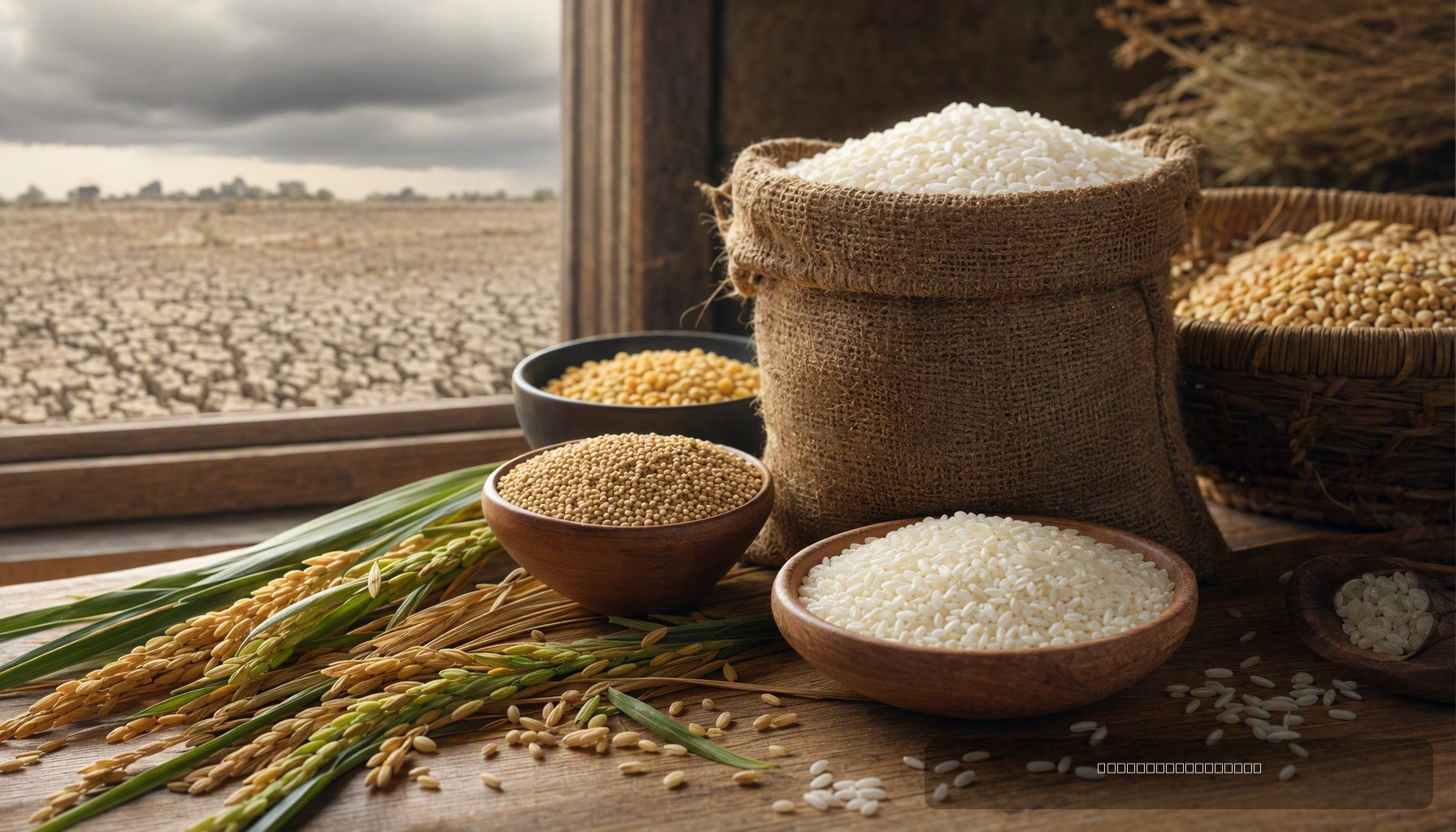
Kharif foodgrain acreage fell 1.6 percent by 5 October 2026. Rice, maize and cereals are all down. El Niño moisture stress could deepen losses before harvest.
Kharif foodgrain acreage across India was 1.6 percent lower year-on-year as of 5 October 2026, according to a Dun and Bradstreet report titled 'Economic impact of monsoon deficit in India: Production, supply chain and price risks', published on 12 October 2026. Total kharif sowing was 1.1 percent below the same period last year. The report attributes the shortfall to El Niño-related monsoon disruption and warns that yield losses will depend on whether rainfall deficits, moisture stress and higher temperatures persist through critical crop growth stages.
The report was published by Dun and Bradstreet, the business data and analytics firm, in October 2026, covering sowing data collected up to 5 October. It covers 20 major producing states and maps production concentration against business exposure in food processing, feed manufacturing and starch industries. The findings matter because India's kharif season, which runs roughly from June to November, supplies the bulk of the country's rice, maize and pulse output. A weak kharif harvest feeds directly into retail food prices, public distribution system procurement and the input costs of packaged-food manufacturers.
What the acreage numbers actually mean
Acreage declines are not the same as production losses. The D&B report is explicit on this: current sowing trends are an early warning, not a measure of eventual output. That distinction matters for anyone reading alarming headlines.
Rice, which the report calls India's dominant foodgrain and a major component of the public distribution system, had acreage 3.5 percent lower year-on-year by 5 October. Rice is moisture-sensitive through most of its growth cycle, so yield performance during the remaining weeks before harvest will determine whether the acreage dip translates into a supply problem. The report notes that strong public rice stocks can absorb moderate losses before they affect food availability or downstream food businesses. The question, as the report frames it, is whether any output decline is large enough to overcome those existing supply buffers.
Maize is a different story. With acreage down 2.9 percent and yields vulnerable during flowering and grain filling, maize faces wider economic exposure than rice. It feeds poultry, livestock and aquaculture, and it is a raw material for starch, processed foods, alcohol and ethanol. Unlike rice, there are no large public maize stocks to cushion a shortfall. If market arrivals fall, feed costs rise for poultry and dairy producers, and input costs climb for starch manufacturers and food processors. The D&B report says the impact on businesses will depend on the extent of supply tightness and their ability to substitute inputs or diversify sourcing.
Other cereals were down 2.3 percent. Pulses face a separate risk: imports can partly offset domestic shortfalls, but they expose supply chains to global prices, exchange rates and trade policy. The report frames the pulse concern as procurement uncertainty and cost volatility rather than an immediate shortage.
Five states — Madhya Pradesh, Rajasthan, Telangana, Maharashtra and Andhra Pradesh — accounted for 1,400.3 lakh tonnes, or 37.7 percent, of foodgrain output across the 20 states analysed in 2025-26. Simultaneous crop stress across several of these states would be difficult to offset elsewhere. Maharashtra alone accounts for 21 percent of businesses in cereal-, grain- and seed-based feed manufacturing. Andhra Pradesh and Telangana host significant concentrations of rice mills and processors. In those ecosystems, production stress can stretch payment cycles and raise counterparty risk across interconnected firms.
What buyers and cooks should watch
For home cooks and clean-label shoppers in India, the immediate practical concern is not a rice shortage. Public stocks are described as substantial, and the report says a moderate production setback can be absorbed without an immediate impact on consumer prices for rice and wheat.
The sharper near-term risk is in maize-derived ingredients. Maize starch, maltodextrin (a partially hydrolyzed starch derived from maize or other grains), corn syrup and similar additives are common in packaged snacks, breakfast cereals and processed foods. If maize market arrivals tighten, manufacturers may face higher input costs and could reformulate or reprice products. Shoppers who already read ingredient labels for maize-derived additives should be aware that sourcing pressures may affect product availability or pricing before any change shows up in official food inflation data.
For buyers sourcing ingredients for plant-based or Ayurvedic food products, pulses are the other category to watch. Dal, chickpea flour, lentil-based proteins and similar ingredients are staples in clean-label formulations. The D&B report does not give a specific pulse acreage figure, but it flags that pulse supply chains have weaker buffers than rice or wheat and are more exposed to import price volatility.
The report does not specify when FSSAI or the Ministry of Agriculture will release updated crop production estimates for kharif 2026. The first advance estimate from the government typically comes in September or October, but the final numbers for kharif output are not available until well after harvest. Until then, the D&B sowing data is the most current public signal available.
For restaurants and cafés sourcing locally grown grains, particularly those in Telangana and Andhra Pradesh that rely on regional rice mills, the concentration risk the report describes is worth factoring into procurement planning now rather than after harvest arrivals begin. The D&B report does not predict crop failure. It says the system has buffers, and those buffers are real. What it flags is that the buffers are uneven across crops, and that maize and pulse supply chains are the ones most likely to feel pressure first.