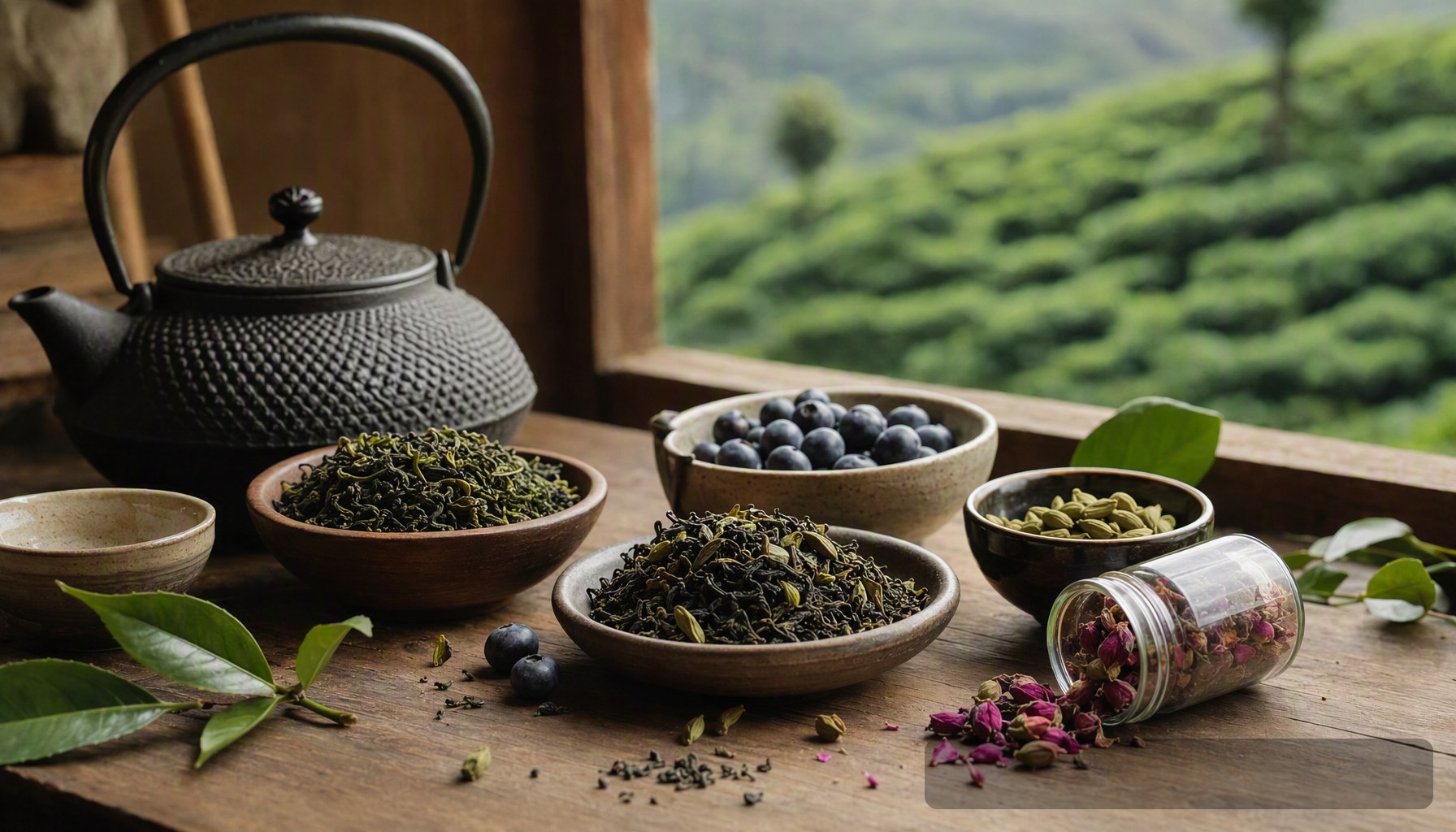
Luxmi Tea's Makaibari Collective pools Darjeeling small-farmer organic tea under one verified brand, sharing profits with cooperatives from Diwali 2026.
Makaibari Collective is a cooperative sourcing model launched by Luxmi Tea Co Private Ltd that channels organic tea from small hillside growers across the Darjeeling region into the established Makaibari brand, starting with its Apoorva and Green Valley product lines, which together represent an existing market of over Rs 10 crore.
The initiative was announced on 1 September 2026 by Rudra Chatterjee, Managing Director of Luxmi Tea Co Private Ltd, with a commercial rollout planned from Diwali 2026. The Collective targets the festive gifting season as its first major sales window while building toward year-round demand. It covers organic-farming cooperatives and self-help groups across Darjeeling, a region whose tea identity has historically been shaped by large estates rather than the thousands of small family plots that also grow there.
What changed
For most small Darjeeling growers, the path to premium markets has been blocked by the cost of brand-building, the complexity of distribution, and the difficulty of meeting international quality standards consistently. The Makaibari Collective sidesteps that barrier by letting participating farmers step directly into an existing customer base rather than building one from scratch.
The mechanics matter here. Makaibari will work with cooperatives to set quality standards and provide training so growers can meet premium and export benchmarks. Crucially, J Thomas and Company, one of India's oldest and most respected tea auction houses, will independently evaluate the quality of tea supplied to the Collective. That third-party verification is the structural detail that separates this from a straightforward brand-licensing arrangement. Every lot is tasted and priced before it enters the pack.
Profit-sharing is pro rata: each cooperative or self-help group receives a share of Collective profits in proportion to the volume of tea it contributes. That formula avoids the flat-fee or fixed-price arrangements that have historically left smallholder growers exposed to market volatility.
From a clean-label standpoint, the model addresses a real gap. Organic certification in Darjeeling is not new, but small growers have rarely had the resources to maintain certification paperwork, fund third-party audits, or access the premium pricing that certification is supposed to unlock. By pooling growers under a single verified umbrella, the Collective creates a structure where certification costs and quality oversight can be shared across a larger base.
It is worth noting what the announcement does not yet specify. The exact organic certification body or bodies covering participating cooperatives has not been named publicly. Whether the Collective will carry a Darjeeling GI (Geographical Indication) tag on pack, which requires compliance with the Tea Board of India's GI protocols, has also not been confirmed. Buyers who care about GI provenance should watch for that detail when products reach shelves.
What buyers and cooks should do
If you buy Darjeeling tea for its terroir, its lack of synthetic inputs, or its traceability, the Makaibari Collective is worth tracking from Diwali 2026 onward. Here is what to check at point of purchase.
Look for the Collective designation on pack. The Apoorva and Green Valley lines are the two ranges being folded into the new model, so packaging should eventually carry language distinguishing Collective-sourced batches from estate-only batches. If it does not, ask the retailer or check Makaibari's website directly.
Verify the organic claim. India's organic food regulations under FSSAI require that any product carrying an organic claim on label must be certified by a body accredited under the National Programme for Organic Production (NPOP) or, for imported inputs, equivalent international standards. The Collective's press materials describe participating growers as organic, but the specific certifying agency has not been named in the announcement. A legitimate organic tea pack will carry the certifying body's name and certificate number on the label or in a scannable QR code.
For gifting, the Diwali 2026 timing positions Makaibari Collective tins and boxes as a clean-label alternative to conventional tea gift sets that may contain blended, non-origin teas with undisclosed additives or artificial flavours. Darjeeling teas at this price point are typically single-origin and additive-free by default, but checking the ingredient list for any added flavouring agents (listed as "natural flavouring substances" or "nature-identical flavouring substances" under FSSAI labelling rules) is still good practice.
For home brewing, first-flush and second-flush Darjeeling teas from small hillside plots often have lighter, more floral profiles than estate teas processed at scale. Brewing at 85 to 90 degrees Celsius rather than a full boil preserves those volatile aromatics. Steep time of two to three minutes is usually enough; longer steeping pulls tannins that mask the character these growers are being paid to protect.
The broader question the Collective raises is whether the model can hold together at scale. Cooperative tea ventures in India have a mixed record. The quality consistency that J Thomas and Company is being brought in to verify will be the deciding factor. If the third-party audit process is rigorous and the profit-sharing formula is transparent, the Collective could become a replicable template for other Darjeeling smallholder groups. If quality slips or the pro rata accounting is opaque, the Makaibari brand carries the reputational risk. Chatterjee's public commitment that every leaf will be "verified, tasted, and fairly priced" before packing sets a standard that consumers and trade buyers can hold the company to.
Sources
- From Darjeeling's hillside plots to wider markets: Makaibari Collective takes root — Hindu Business Line
- Luxmi Group to launch Makaibari Collective with Darjeeling small tea growers — Hindu Business Line
- National Programme for Organic Production (NPOP) — APEDA, Government of India
- Darjeeling GI Tag and Tea Board of India certification protocols