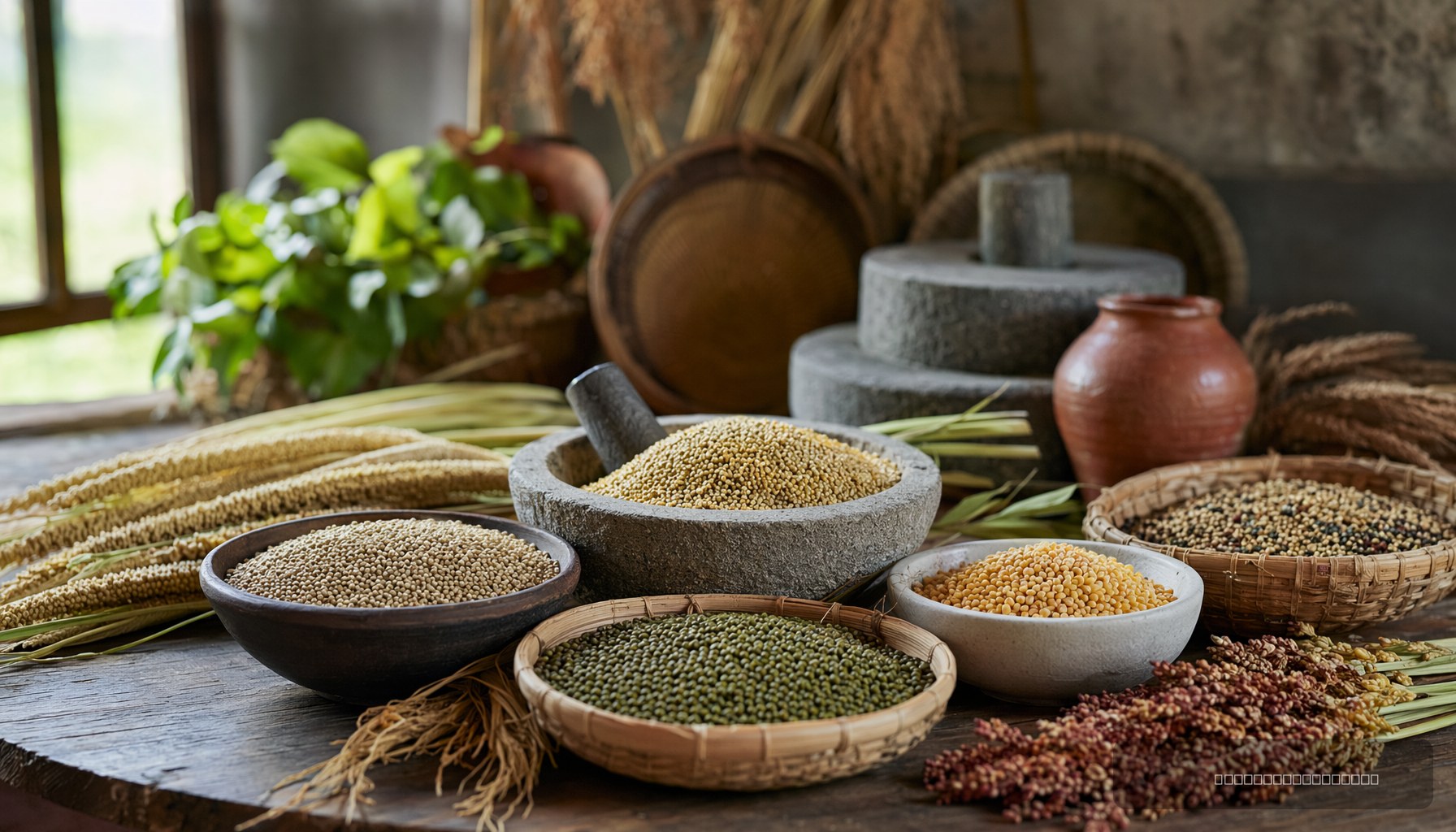
A Karnataka women's SHG runs a seed bank and millet processing unit serving 200+ farmers, winning a UNDP award and showing how rural collectives can anchor India's clean-food supply chain.
Bibi Fatima Women SHG, a self-help group operating out of Ingalagi village in Dharwad district, Karnataka, has established a functioning community seed bank and millet processing unit that collectively benefits more than 200 farmers across nearly 30 villages — making it one of the most concrete grassroots examples of clean, chemical-free food production in rural India today.
The group was started in 2018 with financial assistance from the Ingalagi branch of Karnataka Grameena Bank (KGB), a regional rural bank operating across Karnataka. Shreekant M Bhandiwad, Chairman of KGB, visited the SHG and its associated Farmer Producer Organisation (FPO) centre in late May 2026, using the occasion to argue that women's SHGs are structurally well-placed to conserve indigenous seeds, promote natural farming, process millets, and build markets for organic agricultural products. In 2025, Bibi Fatima SHG received the Equator Initiative Award from the United Nations Development Programme (UNDP), an international recognition given to community-led solutions that advance nature-based sustainable development.
What changed — and why it matters for clean food
India's clean-label conversation has largely been an urban, upper-income phenomenon: cold-pressed oils in Bengaluru delis, heritage grain flours on e-commerce platforms, and Ayurvedic snack brands targeting metro consumers. What Bibi Fatima SHG represents is the supply-side infrastructure that makes any of that possible at scale — and at a price point that doesn't exclude most Indians.
Millet processing is the clearest illustration. Millets such as ragi (finger millet), jowar (sorghum), and bajra (pearl millet) are inherently whole-grain, gluten-free, and low on the glycaemic index. But they reach urban consumers almost exclusively through branded, packaged products that often carry additives — maltodextrin (a partially hydrolyzed starch used as a bulking agent), refined sugar, or synthetic flavours — to improve shelf life and palatability. A local millet processing unit run by an SHG, by contrast, produces flour and value-added products with minimal processing and no supply-chain pressure to extend shelf life artificially. The ingredient list stays short because the economics demand it.
The community seed bank component addresses a different but equally important gap. Indigenous seed varieties — what plant breeders call landraces — have been steadily displaced by hybrid and genetically uniform commercial seeds optimised for yield rather than nutritional density or flavour. Once a landrace disappears from a farming community, it is effectively gone from the food system. SHG-run seed banks are one of the few mechanisms outside government gene banks that actively maintain and redistribute these varieties to working farmers. Bhandiwad's framing of seed conservation as an SHG mandate, rather than a specialist agricultural task, is significant: it embeds biodiversity preservation into the same institutional structure that handles microfinance and women's economic empowerment.
The millet-based mixed cropping system that Bibi Fatima SHG has adopted also reduces dependence on synthetic inputs. Mixed cropping — growing two or more crops simultaneously on the same plot — naturally suppresses weeds, reduces pest pressure, and improves soil nitrogen, which means lower pesticide and fertiliser loads on the final grain. For consumers buying from SHG-linked supply chains, this translates to produce that is closer to organic in practice, even if it hasn't been formally certified under FSSAI's organic food regulations (Food Safety and Standards (Organic Foods) Regulations, 2017).
Formal organic certification remains a barrier for most small SHGs. The Participatory Guarantee System (PGS-India), administered by the Ministry of Agriculture, offers a lower-cost peer-verification route, but uptake among SHG-linked farmers is uneven and documentation requirements can still be onerous for groups operating in low-literacy contexts. Whether Bibi Fatima SHG's produce carries any formal certification — PGS-India, NPOP, or otherwise — is not confirmed in available reporting.
What buyers and cooks should do
If you source millets, pulses, or indigenous grain flours for home cooking or a food business, the Bibi Fatima model points toward a practical sourcing checklist worth applying to any rural SHG or FPO supplier.
First, ask whether the group maintains its own seed stock or buys commercial hybrid seed each season. Groups with community seed banks are far more likely to be growing heritage varieties with distinct nutritional and flavour profiles — the kind of ragi or foxtail millet that actually tastes different from commodity grain.
Second, ask about the processing setup. A village-level millet processing unit typically stone-mills or hammer-mills grain without the high-heat roller milling that strips the bran and germ from commercial flour. Stone-milled ragi flour retains its calcium and polyphenol content in a way that industrially processed flour does not — a distinction that matters if you are buying ragi for its nutritional value rather than just its gluten-free status.
Third, look for FPO linkages. The Bibi Fatima SHG operates alongside an FPO, which means it has at least some collective bargaining infrastructure and is more likely to have consistent quality controls and traceable supply than an informal individual seller.
For urban retailers and clean-label brands sourcing from rural producers, the KGB-SHG-FPO model in Karnataka is worth watching as a procurement channel. Karnataka Grameena Bank's active role in visiting and publicly endorsing SHG agricultural initiatives suggests institutional willingness to facilitate linkages — though the bank has not announced any formal urban-rural clean-food supply programme as of this writing.
The broader policy signal is that India's clean food future is unlikely to be built exclusively by venture-funded brands reformulating packaged snacks. The unglamorous infrastructure of seed banks, village processing units, and women's collectives in places like Ingalagi is where the actual raw material originates. Bhandiwad's observation that SHG participation in agriculture strengthens the rural economy is correct — but for clean-label consumers, the more immediate point is that it also strengthens the integrity of what ends up on the plate.