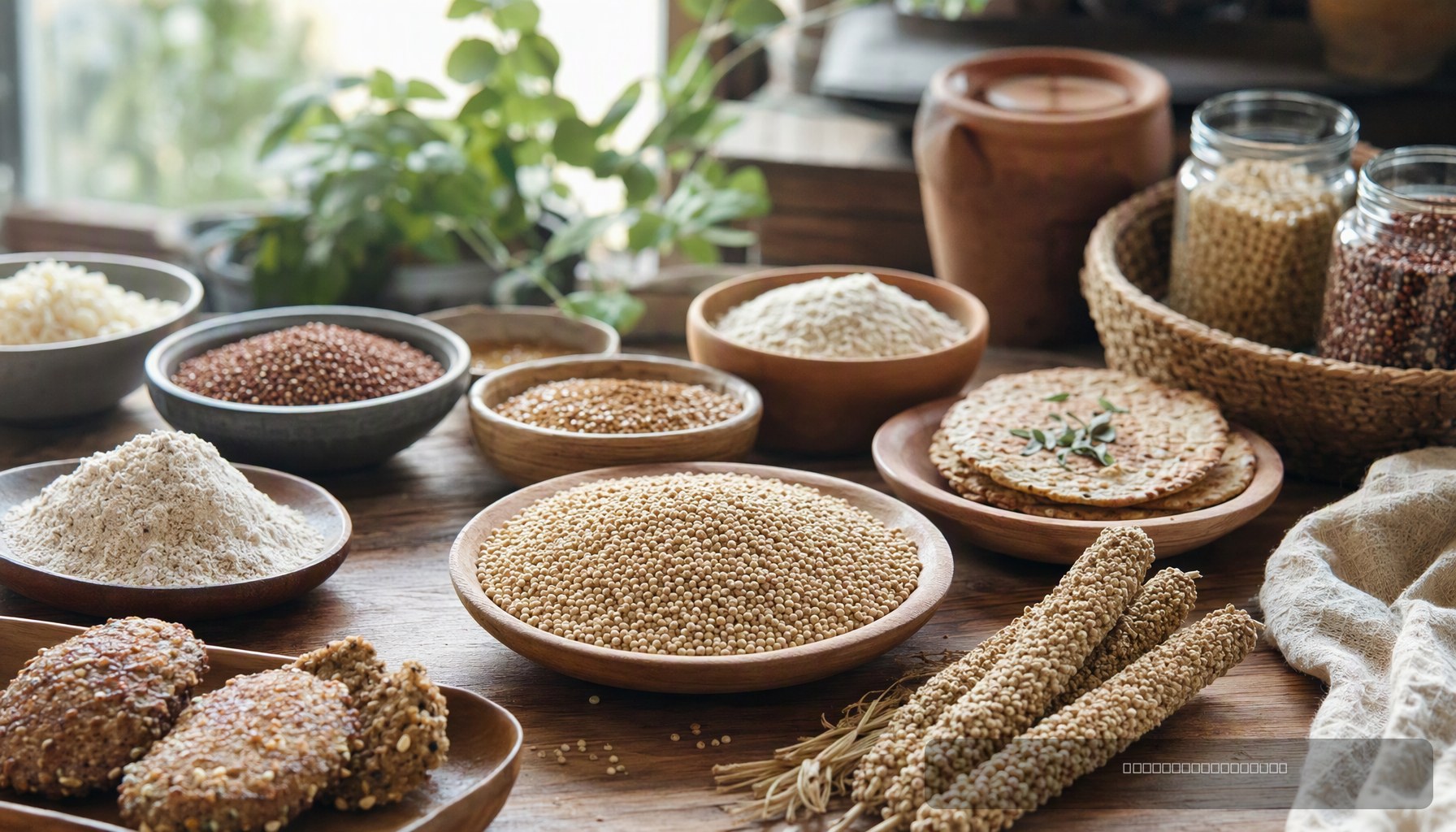
Telangana's SERP is opening five government-backed millet cafés at a cost of Rs 2.2 crore, run by trained SHG women, serving traditional grain dishes at locations in Hyderabad, Yadagirigutta, and Mahbubnagar.
Five government-backed millet cafés are coming to Telangana under a memorandum of understanding between the Society for Elimination of Rural Poverty (SERP) and the Indian Institute of Millets Research (IIMR), at a combined first-phase cost of Rs 2.2 crore.
The Telangana government announced the initiative in late October 2026, with Women Development and Panchayat Raj Minister D Anasuya Seethakka as its public face. SERP, the state body that works with rural women from economically weaker sections, is establishing the outlets at BRKR Bhavan, MCRHRD campus, and Indira Mahila Shakti Bazaar in Hyderabad, plus one each in Yadagirigutta and Mahbubnagar. Construction at the three Hyderabad locations is nearing completion. The stated aim is two-pronged: bring millets back to everyday urban diets, and give self-help group (SHG) women a foothold in the food and beverage sector.
What changed
Millets are not new to Telangana kitchens. Jowar (sorghum), bajra (pearl millet), ragi (finger millet), and foxtail millet were staples across the Deccan for generations before rice and wheat displaced them through the Green Revolution and shifting urban tastes. The UN declared 2023 the International Year of Millets, and the Indian government has since pushed millet promotion through multiple channels, including IIMR's mandate to develop processing and product standards.
What is different here is the delivery model. Rather than subsidised grain distribution or awareness campaigns, the state is funding physical retail points where cooked millet food is sold to walk-in customers. The menu includes ragi sankati, ragi java, millet upma, millet khichdi, pulihora, murukulus, rotis, cakes, and biscuits. That range matters from a clean-label perspective: most of these are single-ingredient or minimal-ingredient preparations with no need for synthetic emulsifiers, preservatives, or refined flour fillers. A ragi sankati, for instance, is finger millet flour and water, cooked to a stiff porridge. There is nothing to hide on a label.
The IIMR partnership adds technical credibility. The institute has already trained 40 women in the first phase of a capacity-building programme covering food preparation, product presentation, sales, and operations. IIMR's research mandate includes developing millet-based food products and setting quality benchmarks, so its involvement suggests the recipes and processes will follow documented standards rather than ad hoc kitchen practice. That said, FSSAI licensing requirements for these outlets, and whether the cafés will display ingredient or nutritional information on their menus, have not been publicly confirmed at this stage.
For clean-label shoppers, the nutritional case for these grains is well-documented. A 2021 review published in Frontiers in Nutrition found that finger millet has one of the highest calcium contents among cereals (roughly 344 mg per 100 g in some varieties), while pearl millet is a meaningful source of iron and zinc. Foxtail millet has a lower glycaemic index than polished rice. None of the four grains used in these cafés contain gluten, which makes the menu naturally suitable for people avoiding wheat.
The SHG angle is also worth reading carefully. SERP's self-help groups are typically composed of women from below-poverty-line households who pool savings and access credit through the state system. Putting them in charge of food businesses, rather than just production, is a step up from the usual model where SHGs supply raw or semi-processed goods to intermediaries. Whether the revenue model, pricing, and supply chain are structured to actually deliver sustainable income to these women is something the government has not detailed publicly yet.
What buyers and cooks should do
If you are in Hyderabad and want to try the cafés once they open, the three city locations are at BRKR Bhavan (Nampally), MCRHRD campus (Jubilee Hills area), and Indira Mahila Shakti Bazaar. The Yadagirigutta and Mahbubnagar outlets extend the reach beyond the city. No opening dates have been confirmed as of 1 November 2026.
For home cooks, the menu at these cafés doubles as a practical template for clean-label millet cooking. Ragi java (a thin finger millet porridge) needs only ragi flour, water, and salt. Millet khichdi swaps rice for foxtail or little millet with dal and minimal spices. These are not reformulated health products with added vitamins and marketing copy. They are grain-forward dishes where the ingredient list is the recipe.
If you buy packaged millet flour or grain for home use, check that the FSSAI licence number is printed on the pack and that the ingredient list contains only the grain, with no added starch, anti-caking agents, or flavour enhancers. Some branded millet mixes sold in supermarkets include maltodextrin (a partially hydrolyzed starch used as a bulking agent and carrier) or added sugar, which defeats the nutritional purpose. Whole grain or stone-milled single-grain flours from regional mills are the cleaner option.
The broader question is whether five cafés, even well-run ones, can shift urban eating habits at scale. Telangana has not announced a second phase or a franchise model yet. For now, the programme is a proof-of-concept: government-funded, institution-backed, and operated by women who have a direct stake in making it work.
Sources
- Millet cafés set to debut in Telangana, create livelihood opportunities for SHG women — Times of India
- Indian Institute of Millets Research (IIMR) — official site
- Millets and their nutritional composition: a review — Frontiers in Nutrition (2021)
- Society for Elimination of Rural Poverty (SERP), Telangana — official site